Performance Overview
This performance overview summarises our purpose, the outcomes we aim to achieve, and the key challenges and risks we face.
STATEMENT FROM THE CHAIR
I am pleased to present our annual report for 2023-24, marking the third year of our current regulatory control period. This report highlights WICS’ achievements and openly addresses the challenges we have faced, reaffirming our essential role in regulating Scotland’s water industry.
REFLECTING ON OUR ACHIEVEMENTS
Over the past year, WICS has played a pivotal role in regulating Scottish Water amidst a challenging economic landscape. We have worked diligently to ensure Scottish Water continues to improve its performance, delivering the best possible value to customers. We have strengthened our regulatory framework and begun reviewing our regulatory approach to prepare for setting charges for the 2027-33 period.
Internationally, the recognition of Scotland’s publicly owned water industry model continues to grow, creating more opportunities for WICS to collaborate with countries seeking to replicate our approach. These key achievements reflect our ambition to continually strive for excellence, developing and improving our regulatory approach to benefit the people of Scotland.
ADDRESSING THE CHALLENGES
This year has also been a particularly challenging period for WICS. In December 2023, the Auditor General issued a Section 22 report1 on WICS’ 2022-23 Annual Report and Accounts, highlighting governance and financial management weaknesses that raised concerns about our focus on value for money. Since then, we have taken decisive action to strengthen our governance and financial controls. We are engaging fully with the Public Audit Committee and other review bodies to ensure we learn from the past and apply those lessons as we move forward.
While these changes have undoubtedly placed WICS in a stronger position, we recognise that meaningful transformation takes time. We are committed to regaining trust and reaffirming our role as an economic regulator that upholds the highest standards in our regulatory approach and how we manage our resources. We will continue to be transparent, reporting on our action plans and holding ourselves accountable for successfully delivering these improvements.
THE IMPORTANCE OF OUR ROLE
Scotland has benefitted significantly from a model where Scottish Water is publicly owned, commercially run, and subject to rigorous economic regulation. This model has kept water charges in Scotland among the lowest in the UK while enabling Scottish Water to make significant investments and improvements in service levels.
The success of our industry underscores the significant impact that robust economic regulation can have—not only in driving operational efficiency but also in ensuring that customers receive high-quality services at a fair price. By carefully setting price caps and closely monitoring financial and operational performance, WICS’ role is fundamental in ensuring that customers pay no more than necessary for essential water and wastewater services.
Economic regulation is also vital to create an environment where innovation can thrive, enabling Scottish Water to adapt to the changing needs of customers and the environment. As we face the challenges of climate change, ageing infrastructure and evolving customer expectations, our regulatory framework is critical to incentivise efficiency, encourage long-term planning, and promote the responsible use of resources.
Economic regulation has clear benefits for customers: It ensures that water services are delivered at the lowest reasonable cost while maintaining high standards of customer care. It also provides the transparency and accountability necessary for the public to trust that their water services are managed efficiently and effectively.
LOOKING AHEAD
Looking ahead, we will maintain our focus on delivering best value for customers, working closely with Scottish Water and other stakeholders to ensure our regulatory framework remains fit for purpose. We are committed to promoting customers' interests, driving efficiency, and supporting the sustainable development of Scotland’s water industry.
I am grateful to our employees and stakeholders for their commitment and engagement as we navigate this period of change and improvement. I look forward to working together to maintain a robust, sustainable water industry that reflects the needs and aspirations of the people we serve.
Ronnie Hinds, Chair
November 2024
SUMMARY PERFORMANCE STATEMENT FROM THE INTERIM CHIEF EXECUTIVE AND ACCOUNTABLE OFFICER
WICS was established in 2005 to ensure that Scottish Water delivers high-quality service while keeping costs fair for customers. This year, one of the most challenging in our history, has tested our resolve and underscored our commitment to this mission. As Interim Chief Executive, I want to reflect on the challenges we have faced, our progress, and our unwavering focus on delivering value for Scotland.
STRENGTHENING GOVERNANCE AND CULTURE
In December 2023, the Auditor General issued a Section 22 report on WICS' 2022-23 Annual Report and Accounts, highlighting governance and financial management weaknesses that raised concerns about our focus on value for money. Following the departure of our CEO at the end of the year, the Leadership Team and I acted swiftly to address these issues. Guided by the insights from the report, we have overhauled our governance and controls including revising our expenses policy, reinstating an approval panel to scrutinise expenditures rigorously, and significantly strengthening our internal reporting processes. These actions help to ensure robust oversight and informed decision-making at all levels of WICS.
Our review of all transactions from the 2022-23 financial year and the first nine months of 2023-24 was crucial in fully understanding the issues raised. This comprehensive approach provided further insights into areas for improvement and has allowed us to support Audit Scotland’s external audit of the Annual Report and Accounts, which we present here. Moving forward, we are fully committed to supporting all reviews, including those by the Public Audit Committee and the Scottish Government, to ensure that lessons from our experiences are shared and contribute to stronger governance across the public sector.
PLANNED CHANGES FOR 2024-25
Despite the challenges we have faced, our focus on delivering our strategic objectives remains resolute. Since my appointment as Interim CEO in March 2024, I have engaged closely with employees, the Leadership Team, the Board, and stakeholders to develop a robust organisational change programme. Our efforts are centred on clarifying roles, responsibilities, and budgets, which will further embed a culture of value for money within WICS. We also recognise the need to strengthen key functional areas such as human resources, risk, assurance and communications.
Our decision to re-establish a physical office presence and adopt a hybrid working model is a significant step in fostering better collaboration and cohesiveness within and across teams. This move will provide our teams with greater opportunities for in-person interaction while retaining the flexibility of remote work. These early steps begin a broader reform journey, paving the way for wider organisational change within WICS.
DELIVERING FOR CUSTOMERS WITH A COMMITMENT TO IMPROVEMENT
Despite our organisation's challenges, we have continued to fulfil our core responsibilities while taking important steps to strengthen WICS and better serve customers, communities and the environment.
Our first strategic objective—supporting the sector vision and ministerial objectives—has been a priority. We refined our regulatory framework to remain robust and adaptable, enabling Scottish Water to meet the Scottish Ministers’ objectives. Additionally, we laid the groundwork for the upcoming Strategic Review of Charges 2027-33, ensuring our approach is informed by lessons learned and stakeholder engagement.
The second objective—challenging Scottish Water to achieve best-in-class service levels—drove us to enhance oversight and data collection. We made significant progress in refining Scottish
Water’s reporting mechanisms, which are vital for setting future price limits and monitoring performance. Our 2022-23 performance report highlighted key improvements, and we implemented crucial changes to ensure continued progress.
For our third objective—international leadership in economic regulation—we aligned with the Scottish Government’s Hydro Nation initiative. Although we paused international project work in 2024 to reassess our approach, we completed significant collaborations, like our work with the New Zealand government. These efforts provided valuable development opportunities for our staff and reinforced our leadership in global water regulation.
A PERSONAL COMMITMENT TO THE FUTURE
As we continue to implement these changes, I am personally committed to rebuilding trust in how we manage ourselves as a public body. The challenges we have faced this year have underscored the importance of transparency, accountability, and continuous improvement—principles we demand of Scottish Water and are equally committed to embedding within WICS. I have every confidence in the strength and dedication of our team, and I am certain that, with our continued focus, we will overcome these challenges and continue to deliver effectively for Scottish customers. Together, we will make WICS a resilient and effective force, consistently providing benefits to customers, communities, and the environment and helping to realise the vision for the water industry in Scotland.
OUR PURPOSE AND STRATEGY
We are a non-departmental public body with a statutory duty to promote the interests of Scottish Water’s customers. We do this by challenging Scottish Water to achieve long-term value and best-in-class service levels for its customers and communities.
We published our Corporate Plan for 2021-27 in December 2020. The plan, which was agreed with Scottish Ministers, explains:
- our strategic objectives
- the outcomes we are setting out to achieve for customers, communities and other stakeholders
- the activities we will need to undertake to deliver these outcomes
- the resources necessary.
Our Corporate Plan is focused on ensuring that we meet our statutory obligations to current and future customers. It will ensure that we contribute fully to delivering the water sector vision. This is particularly important given the need for Scottish Water to achieve net zero emissions by 2040 (on both an operational and an embodied basis) and to maintain service levels by repairing, refurbishing and replacing the industry’s assets in a sustainable way. Climate change will often mean that there is too much water where we do not want it and too little in the places that we do. Scottish Water will be crucial in managing how we adapt to our changing climate.
In our annual report, we report on our progress each year against the objectives set out in the Corporate Plan.
OUR ORGANISATIONAL MODEL
WICS is sponsored by the Scottish Government’s Directorate for Energy and Climate Change.
Our Board comprises four non-executive members (including the Chair) and the Chief Executive Officer (CEO). The Board is responsible for overall governance. Following the departure of the former CEO in December 2023, an interim CEO was appointed in March 2024. In February 2024, we accepted the resignation of one of our Board members. Two interim Board members were appointed on 15 July for a period of 12 months. The governance statement within the Accountability Report covers further information about our Board Members and the role of our Audit and Risk Committee (ARC).
We are funded through a levy on Scottish Water and the retailers participating in the competitive non-household market. Scottish Ministers set the size of these levies in light of the objectives, and key targets agreed through the corporate planning process. Where resources allow, we seek to supplement that income with income derived from the external projects we undertake as part of our international work. However, we have temporarily paused our revenue-generating international activity and continue to engage with the Scottish Government regarding WICS’ future role in supporting the Hydro Nation initiative.
OUR OPERATING ENVIRONMENT
We work closely with many stakeholders, and these relationships are summarised below.
Stakeholder |
Interaction with our work |
| Scottish Parliament | We are accountable to the Scottish Parliament through Scottish Ministers. |
| Scottish Government | The Scottish Government sets the overall objectives and principles of charging for the water industry in Scotland. |
| Scottish Water |
We have a duty to promote the interests of both current and future customers by making sure that:
|
| Scottish Environmental Protection Agency (SEPA) | SEPA regulates Scottish Water’s performance in terms of compliance with environmental standards and investment in improvements. |
| Drinking Water Quality Regulator (DWQR) | The DWQR regulates Scottish Water’s compliance with drinking water quality and investment to protect public health. |
| Consumer Scotland | Consumer Scotland is the statutory, independent voice for consumers in Scotland. Its Board commenced their responsibilities in April 2022 and will take on the water consumer functions previously delivered by Citizens Advice Scotland. |
| Central Market Agency (CMA) | The CMA administers the competitive non-household retail market. It is a separate organisation from the Competition and Markets Authority, a UK body, that ensures markets deliver appropriately for consumers. |
| Scottish Public Services Ombudsman (SPSO) | With responsibility for complaints and dispute resolution in the water sector, the SPSO provides insights into levels of trust and confidence among consumers. |
OUR KEY ACTIVITIES AND PRIORITIES
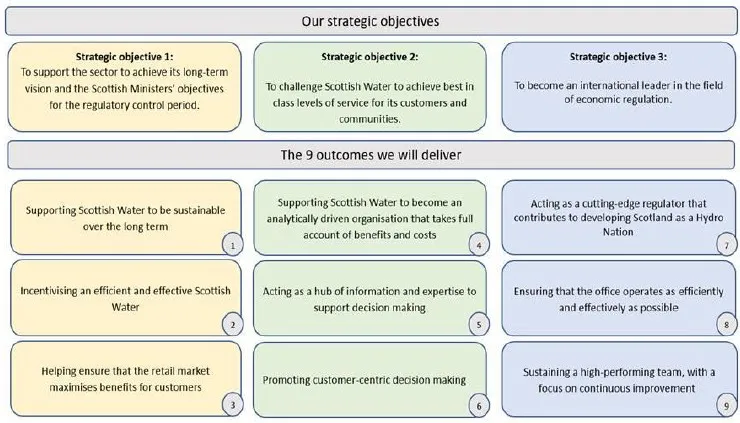
The three strategic objectives identified in our Corporate Plan 2021 are each underpinned by three outcomes. The objectives and outcomes are set out below. Each year, we prepare an annual work plan that sets out the areas of focus and specific activities we will undertake during the year to help us deliver our objectives.
OUR KEY CHALLENGES AND RISKS
The strategic risks identified during the corporate planning process for the 2021-2027 regulatory period were shaped by the context at that time. However, with significant developments since 2021—including challenges such as COVID-19, high inflation, and the findings from the Section 22 report—we recognise the need to reassess these risks. As part of our ongoing organisational change programme, we plan to review these risks during the 2024-25 period comprehensively.
Our principal strategic risk focuses on a potential failure to deliver our statutory duties. Underpinning the principal risk are three strategic risks which focus on:
- Ensuring we are resourced appropriately and that succession plans are in place.
- Staying attuned to the external landscape of the water industry and the strategies of our stakeholders in order to respond to changes.
- Remaining compliant with all relevant laws, regulations and policies and demonstrating the standards expected of a non-departmental public body in Scotland.
This year's events have underscored the critical importance of effective risk management. Addressing strategic risks will be essential in restoring and maintaining trust in our role as an economic regulator and responsible public body.
To manage risk effectively, we are implementing an organisation change programme which includes:
- Adhering to public body governance best practices and ensuring robust Board oversight of governance policies with assurance provided by independent internal and external audits.
- Developing and maintaining policies and procedures that meet the standards expected for a non-departmental public body, supported by legal advice and strong relationships with our Scottish Government sponsor team.
- Regular compliance and action reporting overseen by our ARC.
- Encouraging risk identification and risk management is embedded throughout the full organisation to ensure that all voices are heard, and all risks managed.
More information on our key risks and the impact these have on delivering our outcomes can be found in the risk section of the performance analysis.
Performance analysis
PERFORMANCE AGAINST KEY OUTCOMES
The progress we have made against the nine outcomes is summarised below.
Outcome 1: Supporting Scottish Water to become sustainable over the long term
This year, our primary focus has been shaping our approach for the next Strategic Review of Charges. Building on the lessons learned from the SRC21 process and insights gained from the first three years of the 2021-27 regulatory period, we have initiated a consultative process to draft our methodology for the 2027-33 period. We collaborated with our core stakeholders during the drafting process and will hold a wider public consultation to capture broader views on our proposals from August to October 2024. We aim to publish the final methodology document by December 2024.
During 2023-24, the Scottish Government has consulted on the guiding principles for the water industry as it addresses longer-term challenges, including climate change adaptation and mitigation. These principles focus on equipping the water industry with the necessary tools and legislation to ensure that essential water, wastewater and drainage services can continue to be provided in a changing climate.
We continue to work closely with the Scottish Government and other industry stakeholders to support this policy development work through a ‘Team Scotland’ approach, including through providing supporting analysis. We will also ensure that our approach to the Strategic Review of Charges can adapt to any changes proposed through the policy development work.
This year also marked a significant transition for Scottish Water with the appointment of new Chief Executive Alex Plant. We have worked to establish a strong working relationship with Alex and the rest of the leadership team at Scottish Water, reinforcing our shared commitment to the principles of Ethical Business Practice and Regulation.
Outcome 2: Incentivising an efficient and effective Scottish Water
We continue to work with Scottish Water on developing its reporting mechanisms for the 2021-27 regulatory control period and beyond. This includes requesting an investment baseline from Scottish Water and improving the annual return to ensure that reporting and information remain fit for purpose. We received an interim submission of Scottish Water’s investment forecasts in January 2024 ahead of receiving further information in June 2024. We continue to work closely with Scottish Water to understand Scottish Water’s future investment requirements, including through our participation in the Scottish Government Investment Group (SGIG).
We published our report of Scottish Water’s 2022-23 performance in March 2024. The report found that Scottish Water continued to maintain its performance in line with past performance and welcomed that Scottish Water:
- recovered some of the slippage in capital investment expenditure;
- spent less than the allowed for operating expenditure and expenditure related to legacy Private Finance Initiative (PFI) contracts;2 and
- maintained performance on key levels of service measures.
The report also noted that there are still signs that Scottish Water is experiencing delays in completing projects that were planned to be delivered in the previous regulatory control period covering 2015-21. These delays mean that customers are not yet receiving the full benefits of the investment that they have already paid for. WICS and other industry stakeholders are monitoring performance in these areas closely through the SGIG.
Outcome 3: Helping to ensure the retail market maximises benefits for customers
This year we continued working on implementing a new standard licence condition on financial resilience. The new licence condition (SLC B4) came into effect in April 2023 alongside the modifications to the wholesale service agreement to allow Scottish Water to make the necessary changes to wholesale payment arrangements based on licensed providers’ financial creditworthiness.
This year, we have continued working alongside stakeholders to encourage licensed providers to take ownership of the development and adoption of a Code of Practice. To this end, we have set up a Steering Group with Consumer Scotland and the Central Market Agency to support the development of a Code of Practice and its assurance process.
During the reporting year, we have started reviewing Business Stream’s Governance Code arrangements to ensure they remain robust and fit for purpose.
We have also reopened the licence application process following our temporary suspension of applications pending the development of an assurance process for new entrants.
Outcome 4: Supporting Scottish Water to become an analytically driven organisation that takes full account of benefits and costs in its option appraisals and decisions
We continue to focus on ensuring that Scottish Water takes full account of the benefits and costs in its option appraisals and decisions. For example, in developing our methodology for the Strategic Review of Charges 2027-33, a key theme relates to Scottish Water producing the evidence and analysis on how it plans to meet Scottish Ministers’ Statement of Objectives in the context of the water sector vision. We also expect Scottish Water to provide a range of options for investment, including innovative and nature-based solutions which demonstrate best value for customers. We expect that these options should consider non-financial costs and benefits such as the carbon impact (both operational and embodied carbon) and natural and social capital.
To assist with this objective, we are also planning as part of our methodology for SRC27 to expand the suite of measurements and targets that Scottish Water report to WICS and engage further
with other industry stakeholders to obtain a better understanding of Scottish Water’s costs and performance to place in better context its investment decision making.
Outcome 5: Acting as a hub of information and expertise to support decision-making
We collect information from Scottish Water through an annual information submission called the Annual Return. The Annual Return is the primary source of information that we use to monitor
Scottish Water’s performance against the requirements of the final determination. The Annual Return is also a key source of information for individuals or organisations with an interest in the Scottish water industry. As such, we publish this information on our website and also respond to enquiries requesting information on the Scottish water industry. We have now published this information on our website for the financial year 2022-23.
Another important element of our commenting on Scottish Water’s performance is our wide and detailed understanding of regulatory frameworks and approaches in other countries and jurisdictions. This enables us to identify areas of best practice or innovation in asset-intensive industries, which we can draw on in our work with Scottish Water.
This year, we have continued to share knowledge and expertise with other regulatory organisations and regulated companies at home and abroad. This activity helps us remain at the forefront of regulatory best practices and achieve better outcomes for customers and investment in the water sector in Scotland.
Our Chief Operating Officer has spoken at several key industry events this year, including the Global Leakage, Institute of Water and the British Water conferences.
Furthermore, the OECD invited our former CEO to serve as a peer reviewer for Brazil’s Water and
Sanitation Agency (ANA) in early September. He also provided evidence at the Scottish
Parliament’s Net Zero, Energy and Transport Committee meeting in October.
We have also engaged with international water sector representatives, meeting with Singapore’s
Public Utilities Board in London to discuss industry challenges and climate change impact.
Outcome 6: Promoting customer-centric decision making
This year, we have reviewed different models of customer involvement in developing our approach for SRC27. We have worked closely with Scottish Water and Consumer Scotland to ensure a strong customer and community voice at the heart of SRC27 and are working towards establishing a tri-partite agreement to underpin the customer engagement approach to SRC27. This approach will ensure that the outcome of the Strategic Review of Charges aligns with what customers value most and is a good example of how WICS will fulfil its consumer duty, a statutory duty that comes into force on 1st April 2024, going forward.
Outcome 7: Acting as a cutting-edge regulator that contributes to developing Scotland as a Hydro Nation
We support the Scottish Government’s Hydro Nation initiative by building partnerships with others and sharing our regulatory expertise. Although international project work has been on hold since January 2024, this does not diminish the success of our previous international projects. We have already achieved our commitment outlined in our corporate plan by delivering projects and providing assistance, leading to a net income5 of £1.6m since the start of this regulatory control period.
We have participated in several workshops and events to enhance our network of international project partners. This year, our Director of Price Review visited Romania to conduct a two-day training workshop on the role of economic regulation and information for the staff of ANRSC, the economic regulator of the Romanian water industry and also spoke at ExpoApa. Additionally, we met with representatives from the Singapore Water Agency (PUB) to discuss the challenges faced in the water industry and the impact of climate change. This helps us remain focused on ensuring that we continue contributing to the Scottish Government’s Hydro Nation strategy.
Our international work provides useful opportunities for our employees to build knowledge and skills in interesting new areas and train others in regulation, contributing to their development and progression. Our analysts delivered training to the Fair Trade Commission of Barbados this year when they visited Scotland.
More broadly, we have continued to extend our links with other overseas regulators and organisations, such as the European Water Regulators (WAREG), the Organisation for Economic Cooperation and Development’s (OECD) Network of Economic Regulators, and development banks, such as the EBRD.
Outcome 8: Ensuring that the office operates as efficiently and effectively as possible
As a public body, we are very conscious of our obligations to deliver value for money, and we recognise that this has not been demonstrated sufficiently in the past. Following the Section 22 report this year, we have taken several important steps to improve our governance and controls to better demonstrate value for money in using public funds.
In addition to initial changes to improve our governance and controls, we are embarking on a wider organisational change programme that includes clarifying roles and responsibilities and improving key functions such as human resources and communication. Following our evidence session in March 2024, we have continued our engagement with the Public Audit Committee, Scottish Government and Audit Scotland.
This year we have also begun exploring options to embed a hybrid working model further to strengthen the positive changes within WICS following the Section 22 report and departure of the former CEO.
During the year we have continued to ensure appropriate technical security controls are in place to strengthen our defences in line with the Scottish Government’s cyber resilience framework and Cyber Essentials Plus standards. This work has included continually training employees and updating business continuity arrangements.
Outcome 9: Sustaining a high-performance team with a focus on continuous improvement
This period has been a very challenging year. However, the team have remained committed and focused on the role of WICS. As we progress through organisational change, we are improving our processes and procedures and providing additional training to staff. Key initiatives include:
- Value for Money training: We have implemented targeted training to ensure the most effective use of resources.
- Diversity, Equality, and Inclusion training: We are committed to developing a more inclusive workplace, and our staff participated in training during 2023-24.
- Bullying and harassment awareness training: We have reinforced our focus on creating a safe work environment with dedicated training on these critical issues.
- Health and wellbeing: We are prioritising staff wellbeing and have increased the number of mental health first aiders across the organisation.
In addition, we held two focused sessions on wellbeing for staff in February and March 2024. These sessions have been incredibly helpful in raising awareness about the importance of wellbeing and developing an overall culture of support. As part of this engagement, we asked staff to participate in a Health and Safety Executive survey on stress management standards: demands, control, support, relationships, roles and change.
KEY PERFORMANCE INDICATORS
Our Corporate Plan identified 11 key performance indicators (KPIs) against which we measure the success of delivering our nine outcomes over the regulatory control period. We identified the key KPIs for this financial year, and our performance against each is described in detail in this section.
The KPIs identified for this financial year are outlined in the table below, along with an analysis of how we performed against those indicators.
Outcome(s) |
KPI |
Performance during 2023-24 |
| 1-3 | We will implement a regulatory framework that enables and supports Scottish Water to take full ownership of its relationship with customers and its decision-making. We will report annually to the Board and in our statutory annual report and accounts on progress. | This year, we have begun developing our methodology for SRC27, working with Scottish Water and other key stakeholders. |
| 1-3 | By December of each year, we will publish our annual reports on Scottish Water’s overall performance in delivering the requirements set out in the 2021-27 final determination and identify any gaps that could impact the level of trust among its stakeholders. | Our assessment of Scottish Water’s 2022-23 performance was published in March 2024. The delay was due to several factors, including Scottish Water's request for further commentary on some elements of the annual return and the additional time we required to review the information. |
| 4-6 | Our annual reports on Scottish Water’s overall performance will include an assessment of its progress in ensuring that project appraisals fully assess the economic costs and benefits of investment. This assessment should include aspects such as the carbon impact and natural and social capital. |
We have published our report on Scottish Water’s 2022-23 performance. |
| 4-6 | Our annual reports on Scottish Water’s overall performance will include an assessment of its progress in ensuring that customers and communities are involved in decision-making. This will encompass assessing the extent to which customers could reasonably have confidence that their views are being heard and acted upon. |
Whilst the 2022-23 performance report focused on information and reporting, we have set out our expectations on the approach to customer engagement as part of SRC27. |
| 7 | We will report annually on requests for regulatory advice, information, and expertise from industry stakeholders and international partners and on the nature of our support. | This year, we have responded to requests from international partners to provide advice and information. This includes finalising the work with the Department of Internal Affairs (DIA) in New Zealand and providing training to the Fair Trade Commission from Barbados during a visit to Scotland. |
| 7 | We will support the Scottish Government’s Hydro Nation initiative by delivering projects and assistance, providing a minimum annual net contribution to our income from this work of £300,000. | We concluded our project work in New Zealand and received a net income contribution of £1m, excluding remuneration costs and overheads. |
| 8 | Each year of the Corporate Plan period, we will set out in an annual work plan the activities we will undertake during the year. In the following year, our Annual Report will include information on progress against our work plan. | Our 2023-24 work plan was approved by the Board in April 2023. Regular updates on the work plan are provided to the Board at each board meeting. These updates have informed the summary of performance in this annual report. |
| 8 | We will ensure that our income and costs remain within budget targets over the regulatory control period and will regularly report our financial performance to the Board. | In line with the corporate plan and budget, we delivered our priorities in 2023-24. For more information on the financial results for the year, see the section on financial performance. |
| 9 | We will achieve the office's desired structure by 2025 and ensure that progress remains on track in the interim. | During 2024-25, the focus is on our organisational change programme to review our operations, structure and roles to demonstrate we are operating as effectively as possible. |
KEY RISKS
Strategic risk 1
If we do not properly plan for the succession of key roles or adequately manage our resources and staff retention, the organisation might lose focus and direction, causing significant business interruption.
As a small office, we need to attract and retain the best talent, ensure succession of senior roles, and ensure that all employees have the skills, training, and expertise they need. We will focus on ensuring that we have the resources, skills, and experience in place to deliver the overall strategy and objectives now and in the future.
We continue to support our leaders through individual and team coaching to ensure they have the skills to meet the organisation's needs now and in the future. We have begun reviewing the roles and priority areas for each leadership team member and staff member.
Strategic risk 2
If we are not attuned to the external landscape and the strategies of our stakeholders, we may not be able to respond adequately to political, legislative, or stakeholder-driven changes within the industry.
Throughout the year we have maintained regular stakeholder liaison, including through our participation in a range of industry forums such as the Stakeholder Advisory Group (SAG), the Delivery Assurance Group (DAG) and the Investment Planning and Prioritisation Group (IPPG) and retail market forums.
We maintain contact with leading thinkers within the sector to ensure an innovative approach is maintained. This is developed through regular external engagement sessions with leading-edge practitioners, academics and policymakers. Our Hydro Nation and horizon scanning activities provide a useful source of engagement, external benchmarking and assurance.
Strategic risk 3
If we are unable to act appropriately and proportionately within the expectations of public bodies as set out, from time to time, by the Scottish Government, in compliance with all relevant laws, regulations, and policies, then there is a risk that our activities will be significantly disrupted and our reputation undermined.
The Section 22 report issued in relation to WICS’ 2022-23 Annual Report and Accounts has brought this risk into sharp focus. We are now actively responding to this risk as an ‘issue’ and have taken key steps to improve our governance and controls to demonstrate value for money better using public funds. In addition to revising our expenses policy and introducing an internal approval panel to provide greater scrutiny of expenditure, we have also continued to review our wider policies and procedures to ensure they meet best practices.
In response to the Section 22 report, we have prioritised strengthening our relationship with the Scottish Government sponsor team and officials. This effort ensures clear communication on both sides and enables us to address the issues identified in the report effectively.
Three strategic risks are underpinning the principal risk of our statutory duties' overall failure. Operational risks are managed at a business area level and are linked to the three strategic risks.
FINANCIAL PERFORMANCE
We prepare a detailed annual budget, in line with the Corporate Plan, which is submitted to the Board for approval. We use a comprehensive budgeting and financial reporting system, which aligns with the Scottish Public Finance Manual (SPFM), to compare actual results to the budgets approved by the Board. Management accounts are prepared each month, with significant variances from the budget investigated and reported. Cash flow and other financial forecasts are prepared regularly throughout the year to ensure that WICS has sufficient cash to meet its operational needs.
Financial performance 2023-24
As set out in the financial statements, the net surplus for the year was £1,226,199 (2022-23:
£1,264,866) before corporation tax payable and any adjustments for actuarial gains or losses. The corporate plan for the period 2021-27 outlines how surplus funds will be used.
The total income received for the year was £4,519,241 (2022-23: £5,287,598). The income received from Scottish Water and the licensed providers aligned with the corporate plan.
We received an income of £379,419 (2022-23: £1,185,029) related to the work delivering projects supporting the Scottish Government’s Hydro Nation initiative. Most of this was received from the DIA in New Zealand, a continuation of earlier work we carried out in support of water reform in the country.
We also received £120,014 (2022-23: £105,551) in rent and service charges related to the corporate office's sublease.
The financial year 2023-24 expenditure was £3,377,674 (2022-23: £4,036,890). The main reason for the decrease of £659,216 (16%) was the reduction in travel and associated costs required for the project in New Zealand, which was completed in 2023. The DIA reimbursed this expenditure, which is included in the increased cash balance.
Staff costs have decreased by £312,312 (12%). However, excluding the IAS 19 adjustments6 actual expenditure on staffing costs has increased by 5.8%, which includes a basic award of 2.25%, as approved by the Scottish government, and progression/promotion.
The internal budget agreed by the board at the start of the financial year was a net income position of £580,673. Excluding non-cash items, the actual operating surplus for the year was £898,553. Actual expenditure was below the internal budget in all areas. Analytical vacancies resulted in lower-than-anticipated remuneration costs, and projects requiring consultancy expenditure were pushed back as we worked to respond to the issues raised in the section 22 report.
The Reserve balance as of 31 March 2024 was an asset of £4,595,524 (2022-23: £3,592,251). The most significant difference from the previous year is the income received in relation to the project in New Zealand. Total cash received in the year was £817,606. An additional £70,474 was received in bank interest on cash deposits compared to the previous year. Surplus cash is deposited in a higher interest-earning treasury deposit account.
Supplier payment policy
Our policy is to pay all supplier invoices not in dispute within the terms of the relevant contract and as soon as possible following receipt of an invoice. In line with the Scottish Government’s guidance, we aspire to a 10-working day target for paying bills to businesses in Scotland. Paying supplier bills promptly is a key objective and an important expression of our commitment to supporting business. The average time to pay suppliers in 2023-24 was 6 days (2022-23: 4 days).
The Public Services Reform (Scotland) Act 2010
The Public Services Reform (Scotland) Act 2010 imposed duties on the Scottish Government and public bodies such as WICS to publish specific information about their expenditure. The Act requires us to publish two statements outlining our steps to promote and increase sustainable growth and improve efficiency, effectiveness and economy. The duties of publishing this information are intended to promote greater openness and transparency. We publish a report on our website setting out our response to the requirements of the Act.
SOCIAL MATTERS
Our statutory purpose is designed to deliver environmental, social and economic success. We take our social responsibility seriously and ensure that all staff policies and procedures are current and comply with the most recent legislation.
ANTI-BRIBERY AND CORRUPTION
As part of our zero-tolerance approach towards fraud, bribery, and corruption, we have an employee code of conduct, a whistleblowing policy, and clear policies regarding acceptable levels of gifts and hospitality (both given and received). We actively encourage staff to be aware of appropriate behaviours with customers and suppliers. We maintain a gifts and hospitality register.
No frauds were detected in 2023-24.
We take malpractice very seriously and are committed to conducting our business honestly. We encourage open communication from all those who work for us and want everyone to feel secure about raising concerns. Our internal whistleblowing policy encourages and enables employees to raise concerns confidentially. All staff are protected under whistleblowing laws if they raise concerns in the correct way.
We have an external whistleblowing policy which aims to assist contractors and the general public should they need to raise concerns about the water industry in Scotland.
We received one external whistleblowing report concerning Scottish Water during this reporting period. We promptly requested additional information to support our investigation but did not receive a response. We remain prepared to investigate further if additional details become available. We continue to be alert to instances of whistleblowing and will continue to ensure they are handled appropriately and in full compliance with our obligations.
TRANSPARENCY OF INFORMATION
We aim to be open in everything we do. Our default approach is to publish information on our activities on our website whenever possible. We frequently dialogue with industry stakeholders and present our approach and decisions in published papers.
COMPLAINTS
We value and recognise the learning that complaints can generate and use complaint information to help us improve our services. During the 2023-24 period, we received a complaint concerning the competitive retail market and WICS' handling of related enquiries over a three-year span. After investigating the issues raised, we determined that all relevant guidance had been provided in line with our duties to promote customer interests and ensure the orderly functioning of the retail market. The complaint was successfully resolved and closed within 20 working days.
OUR SUSTAINABILITY PERFORMANCE
Scotland has some of the world's most ambitious greenhouse gas reduction targets, and we wish to contribute as much as we can to help deliver this world-leading climate change action. Public Bodies in Scotland are bound by the Climate Change Public Bodies Duties set out in Part 4 of the Climate Change (Scotland) Act 2009. These duties require public bodies, in exercising their functions, to:
- contribute to carbon emissions reduction (climate change mitigation);
- contribute to climate change adaption; and
- act sustainably.
As a small office, we recognise that the extent to which we can continually reduce our carbon footprint is limited. That said, we do all we can to ensure that our internal office functions are delivered in a sustainable and carbon-conscious manner. Our internal policies encourage employees to make carbon-conscious decisions regarding procurement and travel.
Our employees currently work from home, with external meeting spaces used for collaborative work. The carbon impact of home working has not been assessed, nor has the carbon impact of the venues used for meetings. However, the carbon impact of staff travel is outlined in the table below.
2023-24 |
2022-23 |
|||
| Area | Estimated carbon emissions | Expenditure (£) | Estimated carbon emissions | Expenditure (£) |
| Transport and travel | 0.6 tonnes CO2 | 97,488 | 14.2 tonnes CO2 | 244,686 |
David Satti, Interim Chief Executive Officer
21 November 2024